Why llm-router
One narrow job — rewrite one alias into different upstream model ids, spread across providers, fail over — done by a single static Go binary instead of a control plane.
LiteLLM vs llm-router
| llm-router | LiteLLM | |
|---|---|---|
| Licence | none published yet | MIT |
| Performance | one ~17 MB static binary; measured idle at 5.9 MB RSS, 0% CPU, binds instantly | litellm 1.104 proxy measured idle at 94.8 MB RSS across its two processes, ~25 s from launch to first bind; a Python dependency tree spanning boto3, azure-*, polars, rq, redis and cryptography |
| Security | constant-time key check, inbound credentials stripped, secrets in env, cli upstreams store nothing, no bodies in logs — details below | boots only with a LITELLM_MASTER_KEY; virtual keys, budgets and teams need a Postgres database — a second credential store to run and protect |
| Alias → several providers | per-target model ids, weights, weight-0 failover-only targets | model_name with multiple deployments, weights and fallbacks |
| Wire translation | OpenAI Chat ↔ Anthropic Messages in both directions, streams translated incrementally without buffering | serves the OpenAI format and converts to provider SDKs; passthrough routes for some providers |
| Usage accounting | a SQLite file, one row per request, queryable over /usage with no database server | spend tracking through its database or external callbacks |
| Control plane (keys, budgets, teams) | deliberately none; optional operational console and playground | a core feature |
Both were measured idle on the same machine (macOS, arm64, one worker): llm-router 5.9 MB RSS, LiteLLM 94.8 MB — about 16× — and LiteLLM took 25 s to start serving against llm-router’s instant bind. CPU was 0% for both while idle. Under load the difference is structural: the Go relay copies bytes; the Python proxy parses and re-serialises.
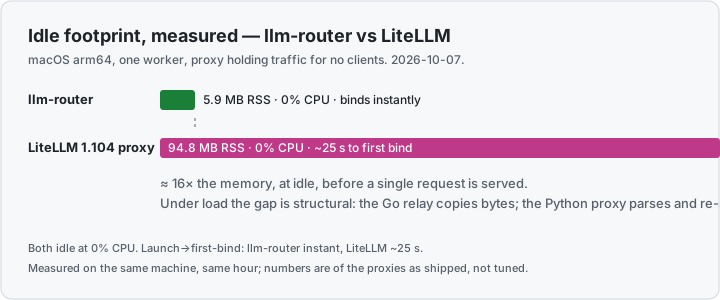
| Measured, idle (macOS, arm64, one worker) | llm-router | LiteLLM 1.104 proxy |
|---|---|---|
| Idle RSS | 5.9 MB | 94.8 MB (parent + uvicorn worker) |
| Idle CPU | 0% | 0% |
| Launch → first bind | instant | ~25 s |
The verdict: if you want provider breadth, virtual keys, budgets and a team console, LiteLLM is the more complete product and is MIT-licensed — use it. If you want one small proxy you can read in an afternoon and run anywhere, llm-router is the smaller tool for that job.
The others
- new-api — closest off-the-shelf fit (per-channel
ModelMapping, priority/weight failover), but AGPL-3.0 plus attribution terms, ~1.4k open issues, and a multi-tenant admin console. - bifrost — permissive and well-run; routing keys off a model name its own catalog recognises, so “same alias, different model id per provider” has no field. Adaptive load balancing is Enterprise.
- GoModel — right design (
virtual_models, weights, affinity); still 0.1.x. - llm-gateway — most on-point config of anything surveyed; 0 stars, 9 commits.
- Rust options (gproxy, oxllm, litellm-rs, the
llm_routercrate) — no tenure yet.
Security
What the code does, verified:
- Constant-time gateway key check.
crypto/subtle.ConstantTimeCompareininternal/router/server.go, applied to inference and/usagealike. - Client credentials are never relayed. Inbound
Authorization,x-api-keyandapi-keyare dropped before dispatch; the target gets only its own configured key. An Anthropic-wire client’s Claude key never reaches whichever provider the alias picks. Hop-by-hop headers are not forwarded. - Secrets live in the environment.
apiKeyEnvis preferred; no key is required inrouter.yaml. On Kubernetes they come from a Secret, not the ConfigMap. - cli upstreams store and proxy nothing. A
kind: cliupstream is rejected at load if it carries anapiKey. The unmodified Claude Code binary runs under your login and the router reads only its stdout — subscription credentials never pass through the proxy, which is also what Anthropic’s policy requires. - Prompts stay off disk. No request bodies in the logs.
- Loopback by default. Set
apiKeybefore exposing the listener; the comparison is constant-time.